
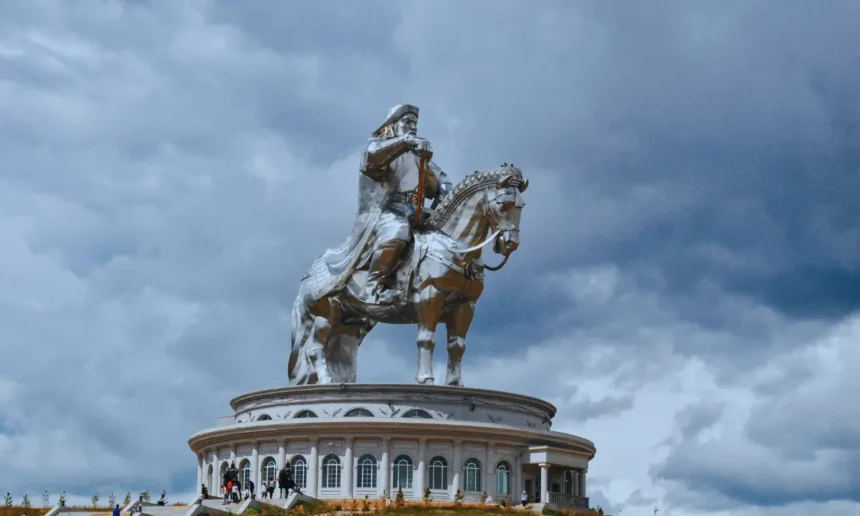
As you drive east from Ulaanbaatar, the capital of Mongolia, the city’s busy streets slowly fade into rolling green hills. The air feels lighter, the sky wider, and suddenly, there it stands — a shining silver giant rising from the steppe.
The Chinggis Khaan Statue Complex (often called the Genghis Khan Statue Complex) is impossible to miss. Standing 40 meters tall (131 feet), it’s the world’s largest equestrian statue — a stunning monument to the man who once ruled the largest empire in history.
Perched proudly atop his horse, Chinggis Khaan (known globally as Genghis Khan) looks out toward the east — the direction of his birthplace. Gleaming under the sun, the statue’s metallic surface mirrors Mongolia’s vast skies, symbolizing strength, unity, and freedom.
Visiting this site is more than a photo opportunity — it’s a journey into the heart of Mongolian pride and history.
A Monument Born from Greatness
Chinggis Khaan (1162–1227) was not only a conqueror but also a visionary who united Mongolia’s warring tribes into a powerful nation. Under his leadership, trade, culture, and communication flourished across Asia and Europe through what became known as the Silk Road.
To honor his legacy, the Tsonjin Boldog site — about 54 km (33 miles) from Ulaanbaatar — was chosen as the perfect location for a monument. According to legend, this was the spot where Chinggis Khaan found a golden whip, seen as a divine sign of his destiny to rule.
The statue was completed in 2008, crafted from 250 tons of stainless steel, and built by the Mongolian company Erdenet. The sheer size and detail are mind-blowing — the horse’s muscles, the folds of the clothing, even the expression of determination on Chinggis’s face.
It’s designed to show him as he might have looked at 40 years old, holding his golden whip, ready to lead his people.
Exploring the Statue Complex
The Chinggis Khaan Statue Complex is more than just a statue — it’s an entire cultural experience.
1. The Walk to the Giant
Your visit begins as you approach the grand marble base. From afar, the statue shines like a beacon across the open plains. As you get closer, its scale becomes almost surreal — you can see tiny figures of people walking beneath the massive horse.
The base building itself is 10 meters high and houses several fascinating exhibits, a museum, and even a restaurant. From the entrance, a sweeping staircase leads you inside, where you’ll start your exploration.
Exploring the Statue Complex
The Chinggis Khaan Statue Complex is more than just a statue — it’s an entire cultural experience.
1. The Walk to the Giant
Your visit begins as you approach the grand marble base. From afar, the statue shines like a beacon across the open plains. As you get closer, its scale becomes almost surreal — you can see tiny figures of people walking beneath the massive horse.
The base building itself is 10 meters high and houses several fascinating exhibits, a museum, and even a restaurant. From the entrance, a sweeping staircase leads you inside, where you’ll start your exploration.
2. The Historical Museum
Inside the base, the museum tells the story of Mongolia’s ancient past and the rise of its greatest leader. You’ll see a collection of traditional Mongolian weapons, tools, and armor, as well as models of yurts (called gers), ancient coins, and maps of the Mongol Empire at its peak.
Life-sized statues of Mongol warriors and detailed displays make history come alive. It’s easy to imagine the power and precision that once carried Mongolian horsemen from the steppes all the way to Europe.
3. The Elevator Ride to the Viewing Deck
One of the most exciting moments comes next. Take the elevator up through the horse’s body, then climb a few final steps to the viewing platform, located right on the horse’s head!
Here, you stand beside Chinggis Khaan’s massive reins and look out over the sweeping Mongolian countryside — miles and miles of untouched green land stretching toward the horizon.
On a clear day, the 360-degree view is breathtaking. The winds whisper across the steppe, and it’s easy to imagine how this landscape once shaped fearless riders and dreamers.
4. The Golden Whip and Symbolism
Every part of the statue carries deep meaning. Chinggis holds a golden whip — a sign of destiny, fortune, and leadership. The direction he faces — east — represents his birthplace and the rise of the Mongol sun.
Even the base of the statue is surrounded by 36 columns, each symbolizing a Mongolian ruler from Chinggis Khaan to the last khan of the empire. It’s not just art — it’s storytelling through architecture.
5. Souvenir Shops and Local Crafts
Before you leave, stop by the souvenir area. You’ll find beautifully handmade crafts: felt hats, eagle-hunter figurines, carved wooden horses, and mini statues of Chinggis Khaan himself. Many of these are made by local artisans, and buying them helps support the surrounding communities.
If you’re lucky, you might even catch a traditional throat singing performance or a short horse-riding show nearby.
A Symbol of Pride and Power
For Mongolians, Chinggis Khaan is more than a historic figure — he’s the soul of the nation. His image is everywhere: on money, vodka bottles, and even in people’s names. But nowhere is his presence felt more powerfully than here, standing tall above the steppe.
The statue represents not just the man but also the spirit of Mongolia — proud, strong, and free. It’s a reminder of what their ancestors achieved and what still connects them to the land today.
How to Visit the Statue Complex
Getting There
The Chinggis Khaan Statue Complex is about 1.5 hours’ drive (east of Ulaanbaatar). You can easily visit it as a day trip.
- By tour: Many travel companies include it in their itineraries, often combined with a stop at Terelj National Park, which is just 30 minutes further east.
- By car: You can rent a car or hire a driver from Ulaanbaatar. The road is paved and in good condition.
Opening Hours
The complex is generally open daily from 9 AM to 6 PM, though hours may vary slightly by season.
Entrance Fees
Expect to pay a small fee for museum access and the elevator to the viewing deck (around a few US dollars).
Best Time to Visit
The statue can be visited year-round, but the best time is between May and September. During summer, the steppe is covered in green grass and wildflowers, and the skies are bright and clear — perfect for photos.
If you visit in winter, the statue surrounded by snow looks majestic, but dress warmly — temperatures can drop well below freezing.
Travel Tips
- Bring sunglasses and sunscreen — the silver statue reflects sunlight intensely.
- Carry a jacket — even in summer, the open plains can be windy.
- Visit early morning or late afternoon — the lighting is stunning, and you’ll avoid crowds.
- Combine with Terelj National Park — see Turtle Rock, visit a nomad family, and enjoy horse riding or hiking nearby.
The Spirit of Chinggis Lives On
Standing before the statue, it’s hard not to feel small — and deeply inspired. The shining figure of Chinggis Khaan seems to command the horizon, reminding every visitor of what determination and unity can achieve.
For travelers, it’s more than a sightseeing stop. It’s a chance to touch a piece of history, to stand in the same winds that once carried messages across an empire, and to feel the strength that still defines Mongolia today.
So when you visit Mongolia, make sure this place is on your list.
Let the wind of the steppe brush your face, stand beneath the towering steel horse, and look up.
You’ll see not just a statue — but the spirit of a nation carved in steel and pride.