
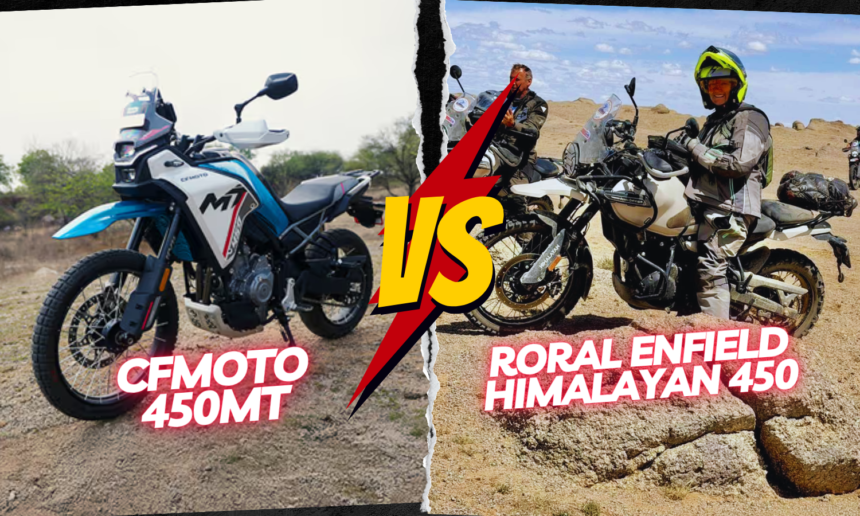
If you’re planning a Mongolia Motorcycle Expedition, choosing the right motorcycle is just as important as choosing the right route.
Both the CFMOTO 450 MT and the Royal Enfield Himalayan 450 are capable adventure bikes.
Both can handle gravel roads, mountain passes, and long-distance touring.
However, if the destination is Mongolia—especially a route like our Ride The Mongolia expedition with around 70–80% off-road riding—the CFMOTO 450 MT has the edge.
That doesn’t mean the Himalayan 450 isn’t a fantastic motorcycle.
It absolutely is.
For many riders, it may even be the better everyday adventure bike.
But when the journey involves sixteen days of remote trails, river crossings, rocky tracks, grasslands, and desert terrain, the CFMOTO’s lighter feel, off-road ergonomics, and suspension give it a clear advantage.
Let’s look at exactly why.
Mongolia Is Unlike Almost Any Other Adventure Destination
Before comparing motorcycles, it’s important to understand the terrain.
A Motorcycle Tour in Mongolia isn’t about riding from one city to another on perfect highways.
Most of the adventure begins where the pavement ends.
Outside Ulaanbaatar, you’ll spend hours riding on gravel roads.
Wide open grasslands become your highway.
Mountain trails replace city streets.
River crossings become part of the day’s ride.
In the Gobi Desert, hard-packed dirt and sandy sections test both rider and machine.
The route constantly changes.
One hour you’re riding across smooth steppe.
The next you’re navigating loose rocks or uneven tracks.
That variety demands a motorcycle that is comfortable, confidence-inspiring, and easy to manage over long days.
It’s not just about power.
It’s about reducing rider fatigue while maintaining control.
That’s where the differences between these two motorcycles begin to matter.
Weight and Handling: The CFMOTO Feels More Agile
Adventure riding is rarely about straight-line speed.
It’s about confidence.
Especially when the surface beneath your tyres keeps changing.
Although the specifications of these motorcycles are relatively close, the CFMOTO 450 MT feels lighter and more agile once you leave the pavement.
That difference becomes noticeable on technical trails.
Loose gravel.
Rocky climbs.
Deep ruts.
River crossings.
Every kilogram matters.
A motorcycle that responds quickly to rider input is easier to correct when traction suddenly changes.
The CFMOTO inspires that confidence.
The Royal Enfield Himalayan 450 also handles rough terrain well.
Its chassis feels stable and predictable.
However, it carries its weight differently.
In slower off-road situations, many riders find it requires slightly more effort to change direction or recover from mistakes.
During a sixteen-day Mongolia Motorcycle Expedition, even small differences become noticeable.
Less effort means less fatigue.
Less fatigue means better riding.
Suspension Makes a Bigger Difference Than Most Riders Expect
Mongolia is famous for its endless corrugated tracks.
Some roads appear smooth from a distance.
Up close, they’re covered in thousands of small bumps.
Ride them for hours, and suspension suddenly becomes one of the most important parts of your motorcycle.
The CFMOTO 450 MT comes equipped with long-travel suspension that feels well suited to this type of riding.
It absorbs repeated impacts without constantly unsettling the rider.
Whether you’re crossing rocky trails or flowing over gravel roads, the motorcycle remains composed.
That translates into confidence.
The Himalayan 450 also offers capable suspension.
It’s a huge improvement over the previous Himalayan generation.
For mixed adventure touring, it performs impressively.
But on long stretches of rough terrain, the CFMOTO simply feels more comfortable and controlled.
That becomes particularly valuable during Motorcycle Tours in Mongolia, where some riding days last several hours across natural terrain.
Standing Comfort Matters More Than Seat Comfort
Many people compare adventure motorcycles by sitting on them in a showroom.
Mongolia changes that perspective completely.
During off-road riding, you’ll spend plenty of time standing on the foot pegs.
Standing improves balance.
It allows the motorcycle to move naturally beneath you.
It reduces impacts reaching your body.
The CFMOTO 450 MT offers an excellent standing riding position.
The relationship between the handlebars, foot pegs, and seat encourages natural body movement.
You don’t feel cramped.
Weight transfers smoothly during climbs and descents.
The Royal Enfield Himalayan 450 is also comfortable.
Its upright riding position makes long highway journeys enjoyable.
However, during extended standing sections, some riders feel the ergonomics require slightly more adjustment.
These are small details.
But after hundreds of kilometres of gravel roads, they become surprisingly important.
Good ergonomics reduce energy loss.
That means you finish each day fresher.
Engine Performance: Both Are Strong, but They Feel Different
This isn’t a case of one engine being dramatically better than the other.
Both motorcycles deliver enough power for Mongolia.
The difference lies in how they deliver it.
The Himalayan 450 produces smooth, usable torque.
It feels relaxed.
Predictable.
Comfortable.
It’s an engine that encourages steady adventure touring.
The CFMOTO 450 MT feels more responsive.
Throttle inputs are quicker.
Acceleration is lively without becoming intimidating.
When overtaking slower vehicles or climbing loose terrain, that responsiveness creates a more engaging ride.
Neither engine struggles in Mongolia.
Both comfortably handle high-altitude riding and long open sections.
But if your priority is spirited off-road performance, the CFMOTO feels slightly more energetic.
For riders who enjoy actively controlling the motorcycle through changing terrain, that’s a genuine advantage.
Long-Distance Fatigue Is the Real Test
Anyone can enjoy a motorcycle for one afternoon.
The real challenge is enjoying it for sixteen consecutive days.
That’s where rider fatigue becomes critical.
Adventure riding isn’t only physical.
It’s mental.
Every gravel corner.
Every unexpected rut.
Every river crossing requires concentration.
The easier your motorcycle is to manage, the more energy you have left to enjoy the scenery.
During our Ride The Mongolia expedition, riders cover an incredible variety of terrain.
The bike becomes your companion from morning until evening.
A motorcycle that feels lighter.
Turns more naturally.
Requires less effort.
And absorbs rough terrain more effectively will usually leave its rider feeling fresher.
This is one of the biggest reasons we believe the CFMOTO 450 MT suits our expedition so well.
Reliability and Practicality
Reliability is essential in remote Mongolia.
Fortunately, both motorcycles are designed for adventure travel.
Both feature modern electronics.
Fuel injection.
ABS.
Adventure-ready chassis.
Both are capable of handling long distances when properly maintained.
The Himalayan has earned a strong reputation for simplicity and worldwide adventure travel.
Royal Enfield’s growing global community also means plenty of owners share maintenance knowledge online.
The CFMOTO benefits from modern engineering and increasingly strong reliability.
Its build quality has improved significantly in recent years.
For a professionally supported Mongolia Motorcycle Expedition, where maintenance and logistics are handled by the tour operator, both motorcycles perform well.
The deciding factor isn’t reliability.
It’s how they behave on Mongolia’s unique terrain.
Which Motorcycle Should You Choose?
If your adventures mostly involve paved roads with occasional gravel, the answer becomes much closer.
The Himalayan 450 is excellent.
Comfortable.
Capable.
Great value.
Many riders will absolutely love it.
However, our expedition isn’t designed around highways.
Approximately 70–80% of the route is off-road.
That’s where the CFMOTO begins to separate itself.
Its handling inspires confidence.
Its suspension feels more composed over rough terrain.
Its standing ergonomics suit long off-road days.
Its lively character makes challenging trails enjoyable rather than tiring.
For the specific conditions we experience during Motorcycle Tours in Mongolia, these advantages matter every single day.
Final Verdict
Both motorcycles deserve respect.
The Royal Enfield Himalayan 450 has become one of the best-value adventure motorcycles on the market.
It’s reliable.
Comfortable.
Capable.
And perfectly suited to many types of adventure travel.
But if your goal is to tackle the demanding terrain of Mongolia, our choice is clear.
For our Ride The Mongolia expedition, we would choose the CFMOTO 450 MT.
Not because the Himalayan isn’t good.
But because the CFMOTO’s lighter handling, excellent suspension, off-road ergonomics, and reduced rider fatigue make it better suited to sixteen days of gravel roads, mountain trails, river crossings, grasslands, and the vast Gobi Desert.
Choosing the right motorcycle won’t make Mongolia easy.
Nothing can.
But it can make every kilometre more enjoyable.
And when you’re riding across one of the world’s last great adventure destinations, that’s exactly what matters most.
Frequently Asked Questions
Is the CFMOTO 450 MT good for a Mongolia Motorcycle Expedition?
Yes. Its agile handling, capable suspension, and comfortable standing ergonomics make it an excellent choice for long off-road adventures in Mongolia.
Can the Royal Enfield Himalayan 450 handle Mongolia?
Absolutely. The Himalayan 450 is a capable adventure motorcycle and can successfully complete a Mongolia expedition. However, for routes with a high percentage of off-road riding, we believe the CFMOTO 450 MT offers a slight advantage.
Why does Ride The Mongolia prefer the CFMOTO 450 MT?
Our expedition includes approximately 70–80% off-road terrain. The CFMOTO’s handling, suspension performance, and rider comfort over rough trails make it especially well suited to those conditions.
Which motorcycle is better for long gravel roads?
Both perform well, but the CFMOTO 450 MT generally feels more agile and composed on long stretches of gravel and uneven terrain.
Is engine power important in Mongolia?
Power is helpful, but control, suspension, ergonomics, and rider confidence are far more important than outright performance during a Mongolia Motorcycle Expedition.